
KOL vs Influencer vs KOC: Key Differences Explained | Complete KOL Marketing Guide

What is the difference between KOLs, influencers, and KOCs? This guide explains clear definitions, benefits of KOL marketing, how to evaluate the right partners, where to find KOLs and influencers, common KOL categories, pricing models, and answers to the most frequently asked KOL marketing questions.
Table of Contents
- What Are KOLs, Influencers, and KOCs? Does KOL Mean Influencer?
(1) What Does KOL Mean?
(2) What Does Influencer Mean?
(3) Supplement: What Does KOC Mean? Is It Different from KOL? - What Are the Benefits of Influencer and KOL Marketing? How Do You Evaluate the Right Partner?
(1) 5 Major Advantages of KOL & Influencer Marketing
(2) 6 Key Points for Evaluating KOL & Influencer Candidates - Where Can Brands Find KOLs and Influencers? Which Channel Is Better?
Influencer Discovery Channel 1: Search on Social Media Yourself
Influencer Discovery Channel 2: Recommendations via Talent Agencies
Influencer Discovery Channel 3: Use Influencer Search Engines
Influencer Discovery Channel 4: One-Stop Professional Matching and Execution via Influencer Marketing Agencies - How Many Types of KOLs and Influencers Are There? KOL Categories and Popular Lists at a Glance
- Are There Differences in Marketing Effectiveness Between KOLs, Influencers, and KOCs? Revealing Common KOL Marketing Questions
- One-Stop KOL & Influencer Marketing Services — Recommended Influencer Matching Agency: GIV!
1. What Are KOLs, Influencers, and KOCs? Does KOL Mean Influencer?
Why can a single recommendation from a KOL or influencer instantly drive massive attention and sales?
In this section, Good Impact Ventures clearly defines KOLs, influencers, and KOCs, explains how they differ, and helps brands understand the unique marketing value of each role.
(1) What Does KOL Mean?
KOL stands for Key Opinion Leader, referring to individuals with long-term expertise, authority, and credibility in a specific industry or field.
KOLs build influence by sharing professional insights, real-world experience, and expert opinions on social media. Unlike influencers who often rely on reach and trending content, a KOL’s impact comes primarily from trust, specialization, and proven knowledge.
Because audiences view KOL recommendations as informed and experience-based rather than purely commercial, KOL content plays a crucial role during the research and decision-making stage of the customer journey and strongly influences purchase decisions.
(2) What Does Influencer Mean?
An influencer is someone who gains attention and influence through consistent content creation, strong personal branding, and high online visibility. Their influence is typically driven by creativity, entertainment value, and audience engagement rather than formal expertise.
Compared to KOLs, influencers are more effective at brand awareness and exposure. Even without professional credentials, their strong connection with followers makes them powerful amplifiers for marketing messages and social buzz.
(3) Supplement: What Does KOC Mean? Is It Different from KOL?
KOC stands for Key Opinion Consumer, meaning everyday consumers who share authentic product experiences and influence purchasing decisions within smaller, highly trusted circles.
Although KOCs usually have fewer followers than KOLs or influencers, their opinions are perceived as highly credible and genuine, making them extremely effective for word-of-mouth and grassroots marketing.
2. What Are the Benefits of Influencer and KOL Marketing? How Do You Evaluate the Right Partner?
Can KOL and influencer marketing truly drive measurable results? And how can brands ensure their marketing budget delivers ROI?
Below, GIV explains the core advantages of KOL and influencer marketing and how to identify partners that align with brand goals.
(1) 5 Major Advantages of KOL & Influencer Marketing

- Precise Audience Targeting
KOLs and influencers typically serve clearly defined audience segments, allowing brands to reach highly relevant consumers. Compared to mass advertising, this precision significantly improves conversion rates and cost efficiency. - Lower Advertising Resistance
By embedding product messages into storytelling, real-life scenarios, and personal experiences, KOL and influencer content feels natural rather than intrusive, increasing acceptance and purchase intent. - Emotion-Driven Purchase Decisions
Purchasing behavior is often driven by emotion. Strong emotional bonds between creators and followers directly influence trust and buying decisions, making KOL and influencer marketing highly persuasive. - Rapid Exposure and Social Amplification
A single post, video, or story can trigger large-scale engagement and algorithm-driven reach beyond existing followers, rapidly increasing visibility and online discussion. - Brand Trust and Reputation Building
Recommendations from trusted creators enhance brand credibility. Positive reviews shared by KOLs or influencers are more likely to be believed and remembered by consumers.
(2) 6 Key Points for Evaluating KOL & Influencer Candidates
📌 Content Style and Brand Fit
Brand values, tone, and positioning must align with the creator’s content style to ensure seamless integration and audience acceptance.
📌 Primary Social Platforms
Platform choice affects content format and audience demographics. For example, Instagram favors visual storytelling, while YouTube is ideal for in-depth reviews and unboxing content.
📌 Follower Demographics
Audience age, gender, and interests should closely match the product’s target market to maximize conversion potential.
📌 Engagement and Interaction Levels
Metrics such as engagement rate, comments, shares, and viewing duration indicate trust and influence more accurately than follower count alone.
📌 Sales Conversion Capability
Past campaign performance, order volume, and conversion data provide insight into real sales-driving power.
📌 Marketing Budget Alignment
Pricing varies widely based on reach, engagement, and content format. Brands should define budgets first, then select partners accordingly.
For limited budgets, nano-influencers (1,000–10,000 followers) or KOCs offer cost-effective entry points.
3. Where Can Brands Find KOLs and Influencers? Which Channel Is Better?
Once evaluation criteria are clear, the next step is choosing the right discovery channel. Below are four common options brands use to find KOLs and influencers.
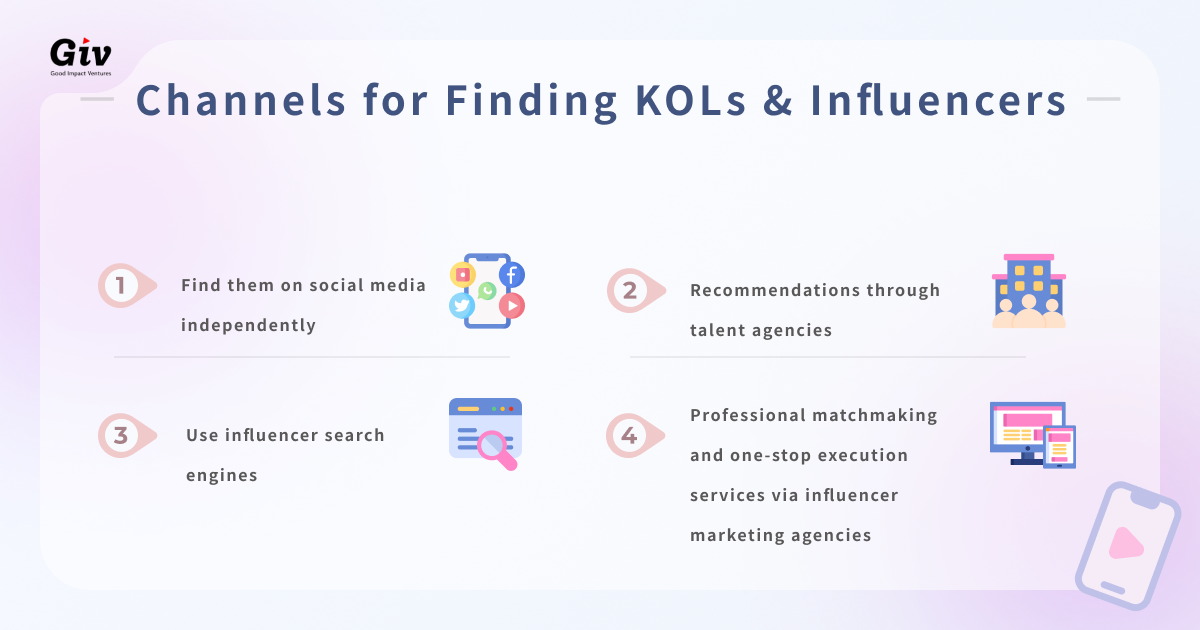
Influencer Discovery Channel 1: Search on Social Media Yourself
Pros:
● Full flexibility and control
● Direct content evaluation
Cons:
● High manpower and time costs
● Limited data and scalability
● High communication effort
Influencer Discovery Channel 2: Recommendations via Talent Agencies
Pros:
● Professional management and contracts
● Faster communication
Cons:
● Limited to agency-signed creators
● Higher collaboration costs
Influencer Discovery Channel 3: Use Influencer Search Engines
Pros:
● Large searchable databases
● Lower subscription costs
Cons:
● No negotiation or execution support
● Brands handle all coordination
Influencer Discovery Channel 4: One-Stop Professional Matching and Execution via Influencer Marketing Agencies
Pros:
● Strategy-driven, end-to-end execution
● Data-backed creator matching
● Reduced risk and operational burden
Cons:
● Service fees apply
4. How Many Types of KOLs and Influencers Are There? KOL Categories and Popular Lists at a Glance
KOLs and influencers can be broadly categorized into the following nine types, helping brands quickly identify suitable collaboration partners:
- KOL Type 1: Beauty & Skincare
- KOL Type 2: Parenting & Family
- KOL Type 3: Travel Sharing
- KOL Type 4: Food & Cooking
- KOL Type 5: Sports & Fitness
- KOL Type 6: Current Affairs Commentary
- KOL Type 7: Knowledge & Education
- KOL Type 8: Pets
- KOL Type 9: Finance
5. Are There Differences in Marketing Effectiveness Between KOLs, Influencers, and KOCs? Revealing Common KOL Marketing Questions
Q1: Which Is More Effective — KOLs, Influencers, or KOCs?
There is no universal best option. The most effective choice depends on brand goals, budget, and product type.
Q2: How Are Collaboration Prices Calculated?
Common pricing models include fixed fees, performance-based commissions, and product-based exchanges.
Q3: Which Industries Are Suitable?
Nearly all industries can benefit from KOL, influencer, or KOC collaborations when aligned with the right audience.
6. One-Stop KOL & Influencer Marketing Services — Recommended Influencer Matching Agency: GIV!
✨ What Are GIV’s KOL & Influencer Matching Advantages?
✅ Extensive Asia-Pacific influencer network
✅ AI-driven precision matching + expert consultants
✅ Reduced communication and management costs
✅ Fully integrated one-stop service
✅ Data-backed performance reporting